TERRA SUB HASTA
04.2026
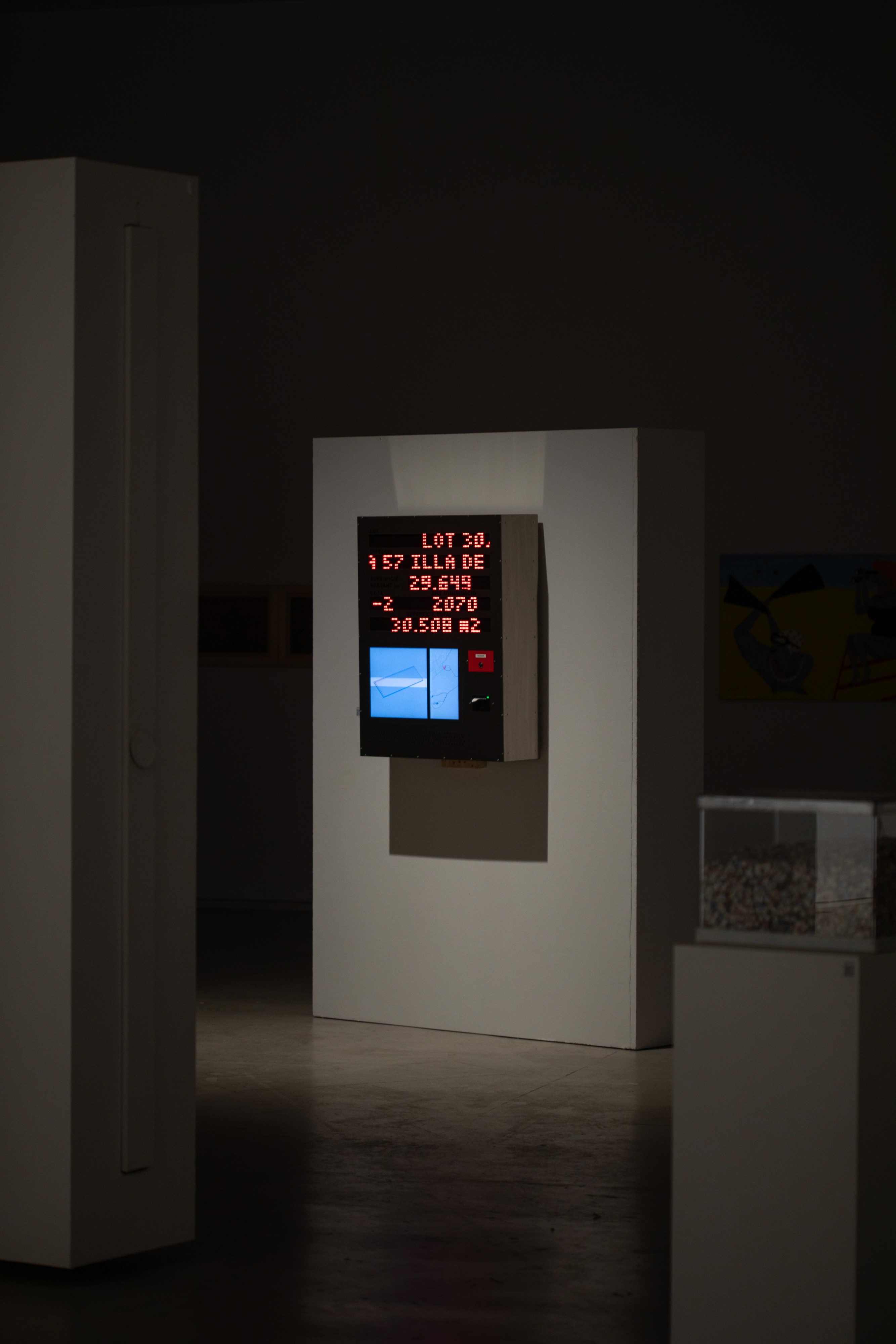
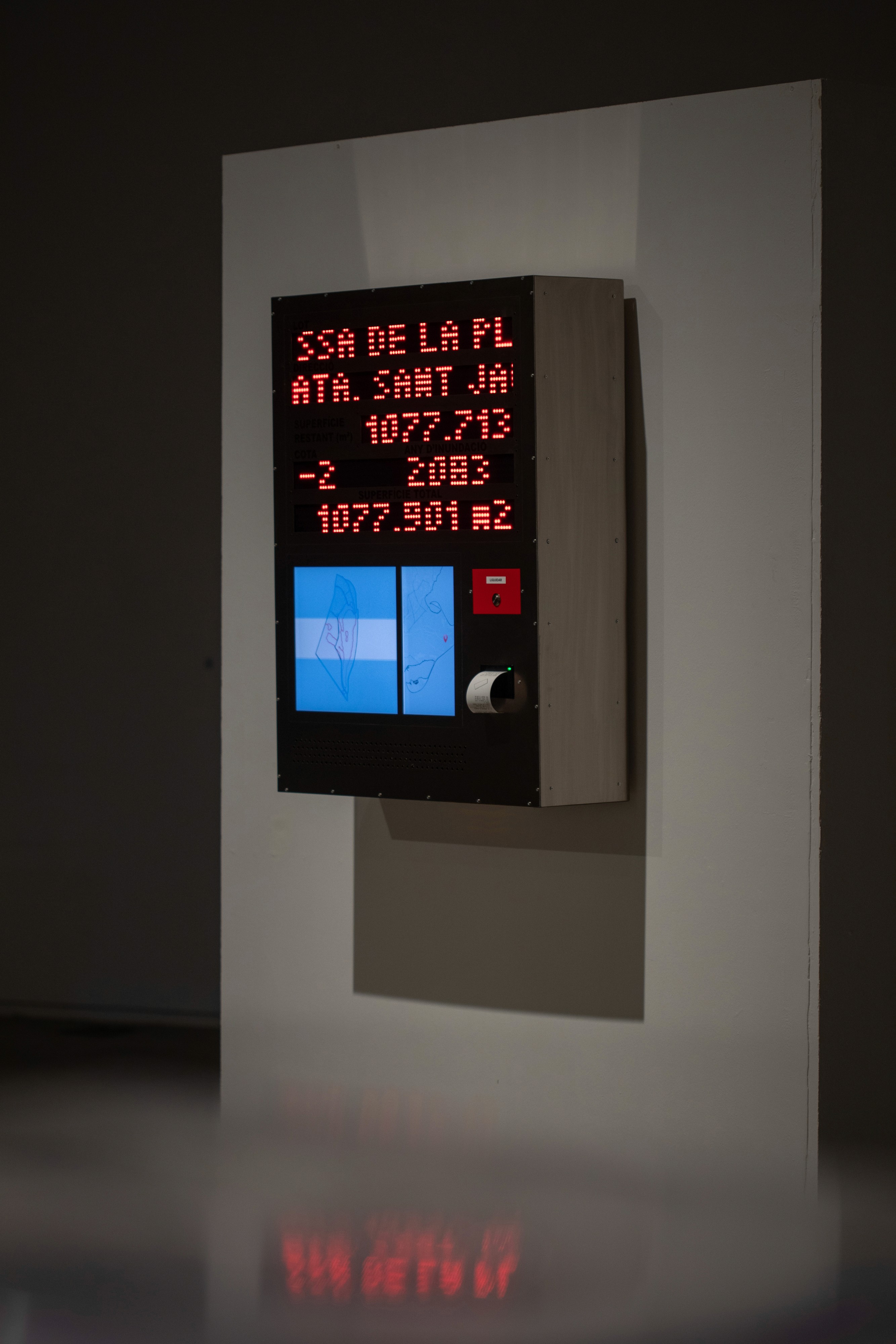
TERRA SUB HASTA adopts the functional aesthetic of the fish auctions of the Ebro Delta, reproducing one of their display and sales devices: a market information display, two image screens, a push button, and a thermal ticket printer. The whole piece is presented in a vertical format measuring 90 × 70 cm, housed in a metal box. At the top is a market-style counter displaying basic information in red LEDs; below it, two screens show the image of the “auctioned” lot and its location on a map of the Delta; to the right, integrated into the same structure, a red button triggers the purchase and a small printer issues the proof of acquisition. The work was presented at the collective exhibition S/C on April 2026, at Centre d'Art Lo Pati, Amposta.
The piece shifts this language of commercial exchange into a speculative fiction: what is being auctioned here is not fish, but plots of land in the Ebro Delta, a territory threatened by subsidence, coastal retreat, and severe ecological degradation. The transaction proposed by the work is not based on the land as it exists today, but on its future condition: the viewer does not acquire the plot in its current state, but rather the right of access and use of that land once it has been flooded.
The work is grounded in a specific documentary basis concerning future prospects for the Ebro Delta. It draws in particular on the studies LIFE EBRO ADMICLIM. Avaluació de les zones vulnerables a la subsidència i la pujada del nivell del mar al Delta de l’Ebre, on coastal retreat and the distribution of subsidence across the delta plain, and Assessing Flood Risk Under Sea Level Rise and Extreme Sea Levels Scenarios: Application to the Ebro Delta, focused on the increasing flood risk resulting from the combination of sea-level rise, subsidence, and extreme events. It also incorporates as a working framework the exhibition El Delta de l’Ebre i el canvi climàtic, curated by the Department of Environment and Sustainability of the Catalan Government.
Each lot is identified on the counter by a series of fixed data: the name of the plot, for example, “Lot 09: inland rice field, building”; cadastral address; total surface area in square metres; elevation; and estimated year of flooding. Alongside this information appears a dynamic figure: the plot’s available surface area, which rapidly decreases in real time. This decrease functions as a mechanism of urgency. The viewer can press the red button to stop the count and acquire the portion of land still remaining at that precise moment; if they fail to intervene in time, the surface area reaches zero and the lot is lost, automatically giving way to the next one.
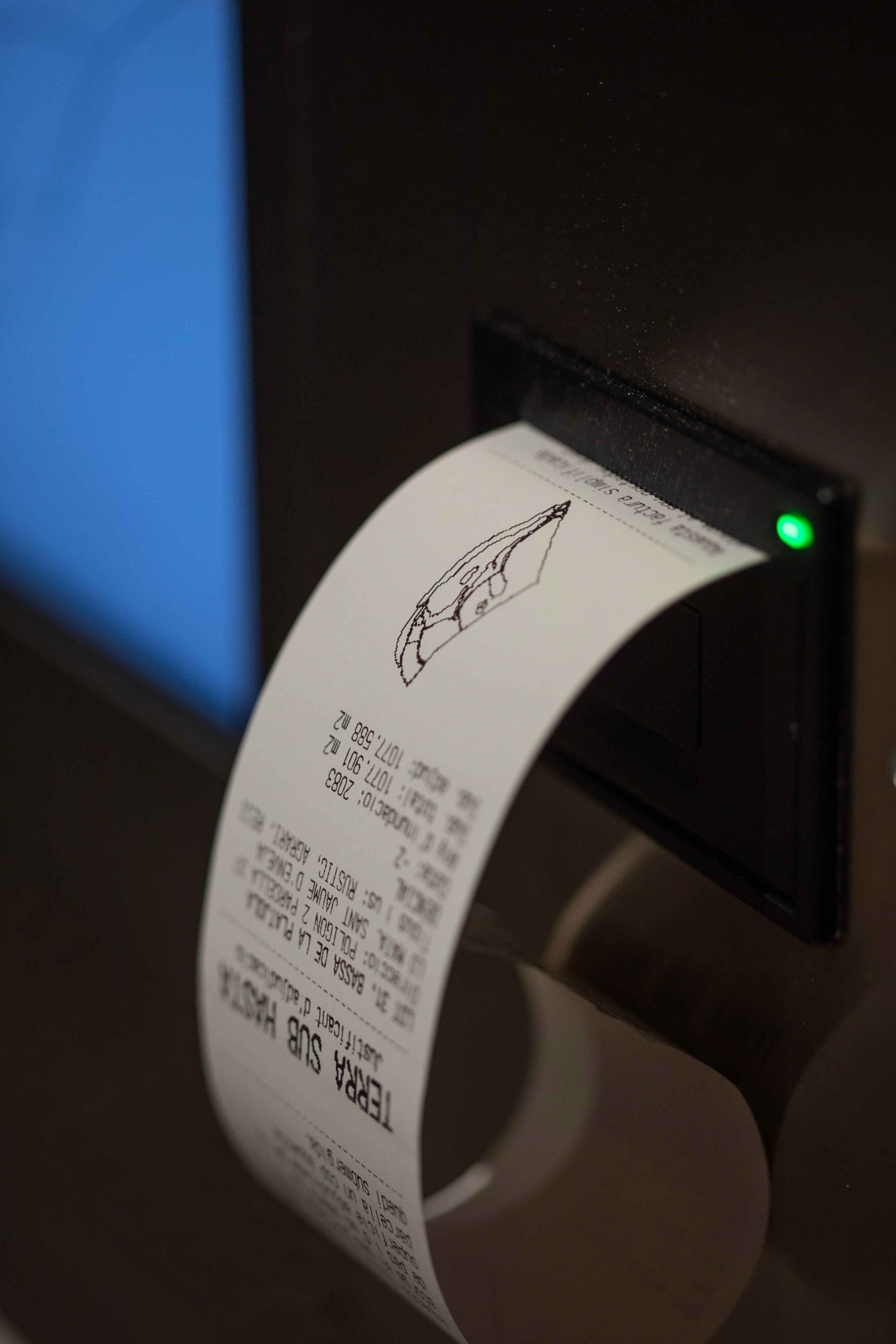
If the visitor presses the button, the thermal printer issues an ordinary ticket, similar to a commercial receipt, recording the completed transaction. It includes the lot data, the surface area actually acquired at the moment of pressing, and the outline of the plot according to its cadastral record. This ticket functions at once as receipt, certificate, and material trace of an absurd transaction: the acquisition of a future right of use over land already condemned to be submerged.
In its current state, the work offers a total of 50 lots for auction. Most are agricultural fields and rice paddies, though they also include more specific cases such as private homes, livestock farms, and even facilities such as schools or a church, all of them located in areas threatened by flooding. The total area covered by these 50 plots amounts to 5,140,232 m², an infinitesimal portion when compared with the scale of the at-risk territory described in the study Assessing Flood Risk Under Sea Level Rise and Extreme Sea Levels Scenarios: Application to the Ebro Delta. Taking as a reference the approximately 320 km² of above-water surface area of the Ebro Delta, the article predicts that, in the absence of adaptation measures, permanent flooding caused by sea-level rise and subsidence will affect between 36 and 45% of the delta by 2050, and between 61 and 73% by 2100. If storms and extreme marine events are added to the equation, the exposed area would rise to between 57 and 63% in 2050, and between 84 and 91% by the end of the century. In other words, the surface area that the work currently puts into circulation amounts to less than 5% of the flooding projected under the most benign scenario for 2050, and less than 2% when set against the most severe scenario projected for 2100.
In this sense, the work is conceived as a living, cumulative device whose form does not remain fixed, but is transformed with each public activation. The 50 lots currently “auctioned” constitute only a first section within a much larger territorial scale: once assigned, they do not re-enter circulation, but are replaced by 50 new plots in future presentations of the piece. In this way, each exhibition alters its state, expands the distribution, and progressively shifts the register of the affected land, until the logic of the auction extends across the whole set of terrains at risk of flooding.
The work thus proposes a reflection on contemporary forms of representation, exploitation, and anticipation of territory. It borrows the fast, everyday, functional device of the fish auction, intimately bound to the local economy of the Delta, and turns it into an interface for ecological speculation. The viewer’s gesture, apparently simple and even playful, becomes implicated in an unsettling operation: participating in the future distribution of a disappearing landscape. The piece places the public in an ambiguous position, somewhere between witness, buyer, and opportunist, and confronts market logic with the material fragility of a threatened territory. In this sense, the title, TERRA SUB HASTA, condenses the conceptual core of the work: a Latin expression meaning “land auctioned off,” it refers to the ancient Roman practice of marking goods destined for auction with a spear, while also activating a second meaning: that of land beneath the spear, exposed, enclosed, and subjected to an imminent threat.